Monday, May 2, 2011

Alicyclics and Aromatics:

1. Carbon Chains can form two types of closed loops
2. Alicyclics are loops usually made with single bonds
3. If the parent chain is a loop standard naming rules apply with one addition:
    "cyclo" is added in front of the parent chain
 
   
Cyclopeptane:

1. There are three different ways to draw organic compounds

complete structural diagrams: 

condensed structural diagrams: 

2. Numbering can start anywhere and go C.W. or C.C.W on the loop but side chains need
    the lowest numbers possible

ex: trimethyl hexane : 

3. Loops can be a side chain
4. Same rules apply but the side chain is given a cyclo-prefix

ex: cyclobutyl octane 

Aromatics:


1. Benzene [ C6H6 ] is a cyclic hydrocarbon with unique bonds between the carbon atoms
2. Structurally it can be drawn with alternating double bonds
3. Careful analysis shows that all 6 C-C bonds are identical and really represent
     a  1.5 bond
4. This is due to e- resonance
5. E- are free to move all around the ring

Aromatic Nonmenclature:


1. A benzene molecule is given a special diagram to show its unique bond structure
2. Benzene can be a parent chain or side chain "phenyl"

ex:  pentamethyl benzene 

Thursday, April 28, 2011

Alkenes & Alkynes

  Since Carbon can form multiple bonds, it is possible for it to form double and triple bonds with other carbon atoms. When multiple bonds are created, fewer Hydrogens are needed to attach to the Carbon atoms. The naming rules are very similar to that of the naming rules for Alkanes.

 1. The position of the double or triple bonds must always have the lowest numbering scheme and is put in front of a parent chain. They take priority over the side chains.

CH3
|
CH2
|
                                                             CH2 = CH2 - CH2 - CH3
                                                               1        2        3       4

3 ethyl 1 butene

CH3
|
                                                                        CH3 - C - CH2 - CH = CH
|
CH3
                                                                          5     4       3       2       1

4, 4 diethyl 1 pentyne  

2. Double bonds end in '-ene' and are known as Alkenes. In diagrams, they are represented by a double line.


3. Triple bonds end in '-yne' and are known as Alkynes.In diagrams, they are represented by a triple line.


Check out this PDF for more practice problems:
http://www.mouatonline.com/Teachers/BHutchinson/Chemistry/Chem11/Unit%207/PS%207.2%20-%20Alkenes%20etc%28ans%29.pdf

Try these videos out too and learn more about Alkenes & Alkynes!
http://www.youtube.com/watch?v=KWv5PaoHwPA
http://www.youtube.com/watch?v=TBQjbGcUcUw&feature=related

Wednesday, April 27, 2011

Organic Chemistry

  Essentially, organic chemistry is the study of many different carbon compounds as carbon can form multiple covalent bonds. The number of organic compounds escalate to approximately 17,000,000 and can form chains, rings, or branches. The simplest organic compounds are composed of Carbon (C) and Hydrogen (H):


 EX.1: Above is an example of an organic compound called ethane.

  Saturated compounds exist with no double or triple bonds. Therefore, compounds with only single bonds are called Alkanes and always end in '-ane'. There are three categories of organic compounds:
  1. Straight Chains
2. Cyclic Chains
3. Aromatics

But today, we will only look at the composition of and naming of the straight chains:

1. Circle the longest continuous chain (this means the longest number of carbons in a row without going back on the chain). This will become the BASE or PARENT chain and can be determined by choosing a prefix and then adding the ending '-ane'.

meth=1 carbon atom
eth=2  carbon atoms
prop=3 "
but=4 "
prop=5 "
hex=6 "
hept=7 "
oct=8 "
non=9 "
dec=10 "

*IN THIS CASE, THE PARENT CHAIN WILL BE HIGHLIGHTED AND WE WILL BE USING A STRUCTURAL DIAGRAM.

                                                                                CH3 CH3
                                                                                  |      |
                                                                      CH3 - CH - CH - CH3

butane
2. Number the base chain in a way so that the side chains (anything not circled as your longest continuous chain), have the lowest possible numbering scheme.

*NUMBERING COULD START FROM LEFT OR RIGHT SIDE IN THIS CASE AS IT MAKES LITTLE DIFFERENCE.

     CH3 CH3
                                                                                  |      |
                                                                      CH3 - CH - CH - CH3
                                                                        1       2      3      4

butane
3. Name each side chain using one of the following prefixes with their '-yl' ending.

methyl=1
ethyl=2
propyl=3
butyl=4
propyl=5
hexyl=6
heptyl=7
octyl=8
nonyl=9
decyl=10

     CH3 CH3
                                                                                  |      |
                                                                      CH3 - CH - CH - CH3
                                                                        1       2      3      4
                                                                           -methyl -methyl butane

4. Give each side chain the appropriate number. If there are more than one of a certain side chain, you would have to number and label accordingly with added prefixes (di for 2, tri for 3, etc.)

     CH3 CH3
                                                                                  |      |
                                                                      CH3 - CH - CH - CH3
                                                                        1       2      3      4
                                                                         2, 3  dimethyl butane

5. When providing the final name for the compound, you must list the side chains alphabetically.

2, 3  dimethyl butane 

For more practice, try out these worksheets: 
http://www.arps.org/users/hs/thompsom/chemcom/unit_3/Naming_Alkanes_Worksheet_1.pdf

& while you're at it, check out this video on naming Alkanes!
http://www.youtube.com/watch?v=KKAD-OOOHxg


Wednesday, March 30, 2011

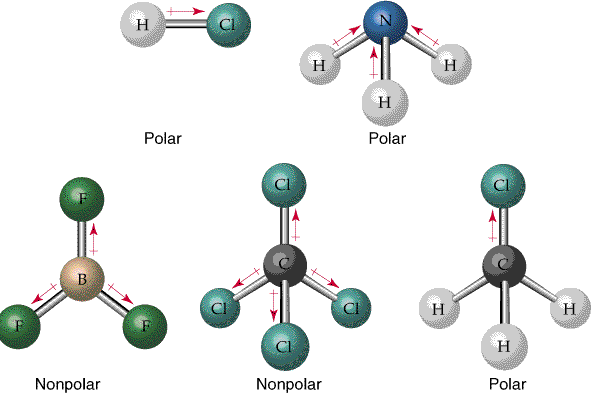
Polar Molecules

  In polar molecules, there is an overall separation in charges. An important aspect in determining whether a molecule is polar or non-polar is to look at its diagram and see if there is any symmetry. If a molecule is unsymmetrical, it is usually polar and if it is symmetrical, it would usually be non-polar. If one was to figure out that the molecule was non-polar, that would mean that the pull of the electrons is usually balanced. After determining if a molecule is polar, that would mean that the molecule has either different atoms or a different amount of atoms. One would then use signs to show which side is partially positive or partially negative.

EX.1:


Wednesday, March 16, 2011

ION CONCENTRATION:

HCl---> H+1 + Cl-1 [dissociation]

Dissociation:
1. Ionic compounds are made up of two parts:
    - cation: positively charged particle
    - anion: negatively charged particle

2. When ionic compounds are dissolved in water, the cation and anion separate from each other

3. This process is called dissociation

4. When writing dissociation equations, the atoms and charges must balance

5. The dissociation of sodium chloride is:
     NaCl---> Na+ + Cl-
ex: 1. Fe[OH]2=---> Fe+2 + 20H-1
      2. Na3PO4=---> 3Na+1 + PO4-3
      3. Fe3[PO4]2= 3Fe+2 + 2PO4-3
      4. If the volume doesn't change then the concentration of individual ions depends
          on the balanced coefficients in the dissociation equation
          a. Determine the {Na+} and {PO4}-3 in a 1.5M solution of Na3PO4
          Na3PO4 [1.5M]---> 3Na+[4.5M] + PO4-3[1.5M]
1.5mol/L x 1/1= 1.5mol/L

6. Determine both ion concentrations when a 2.5M solution of lithium sulfate dissociates
    Li2SO4[2.5M]---> 2Li+ + SO4-2
    {Li+}= 5.0M
    {SO4-2}=2.5M
     ZnCl2[0.376M]---> Zn+2 + 2Cl-1[0.752M]
7. A 100ml solution of 0.500M PcCl2 is added to 200ml solution of 0.100M
    NaOH. Determine the final concentration of each ion
    PbCl2[0.500M]--->Pb+2[0.500M] = 2Cl-1[1.00M]

c1v1= c2v2

[0.500M][0.100L]= c2[0.300L]
c2= 0.167M= [Pb+2]
c1v1=c2v2
[1.0M][0.1L]= c2[0.300L]
c2=0.333M=[Cl-1]
c1v1=v1v2
[0.100][0.200L]= c2[0.300L]
c2=0.0667M= [Na+] = [OH-1]
        

Sunday, March 13, 2011

Titrations

-A titration is an experimental technique used to determine the concentration of an unknown solution.

Terms and Equipment
- Buret contains the known solution. Used to measure how much is added.
- Stopcock valve used to control the flow of solution from the the buret .
- Pipet is used to accurately measure the volume of unknown solution.
- Erlenmejer Flask contains the unknown solution
- Indicator is used to identify the end point of the titration.
- Stock solution is the known solution.
http://www.youtube.com/watch?v=9DkB82xLvNE

Monday, March 7, 2011

Dilutions

  It is evident that when two solutions are mixed, the concentration (measured in mol/L) changes. In the process of dilution, the concentration is decreased by adding a solvent, or any substance that dissolves another substance (usually water.) Similarly to how one adds one cup of water to one can of juice concentrate, or how one adds one cup of water to one can of soup, the substance that is dissolved (solute) does not change in amount. This could be explained with the equation:
n1 = n2    ->    c1v1 = c2v2

 Where c=Concentration, n=number of moles, & v=volume.

EX.1:
Determine C when 200 mL of 0.30 M of Sodium Nitrate (NaNO3) is diluted to a final volume of 600 mL.

1. Remember to first convert mL to L as M is measured in mol/L. After doing so, write out your equation that explains the conservation of the solute before and after dilution.

200 mL  x  1 L    =    0.200 L                     600 mL  x  1 L    =    0.600 L
              1000 mL                                                  1000 mL

c1v1 = c2v2

2. With the information you are given in the question, plug in the numbers into your equation and isolate the variably you are looking for.

(0.30)(0.200)  =  C2(0.600)
                                                                    (0.600)           (0.600)

3. Once you have isolated your variable, calculate & answer the question with correct amount of significant digits.

(0.0600)  =  C2
                                                                                                (0.600)

                                                                       0.10 mol/L = C2

In order to answer other questions similar to this one, you have to consider what is it that the question is asking you to find? In most cases you will have to isolate the variable of which you are solving for.

For more examples on this topic, check out these links:
http://misterguch.brinkster.net/PRA025.pdf
http://www.youtube.com/watch?v=ygr0CGdkAws